Facial recognition at the door: how it works
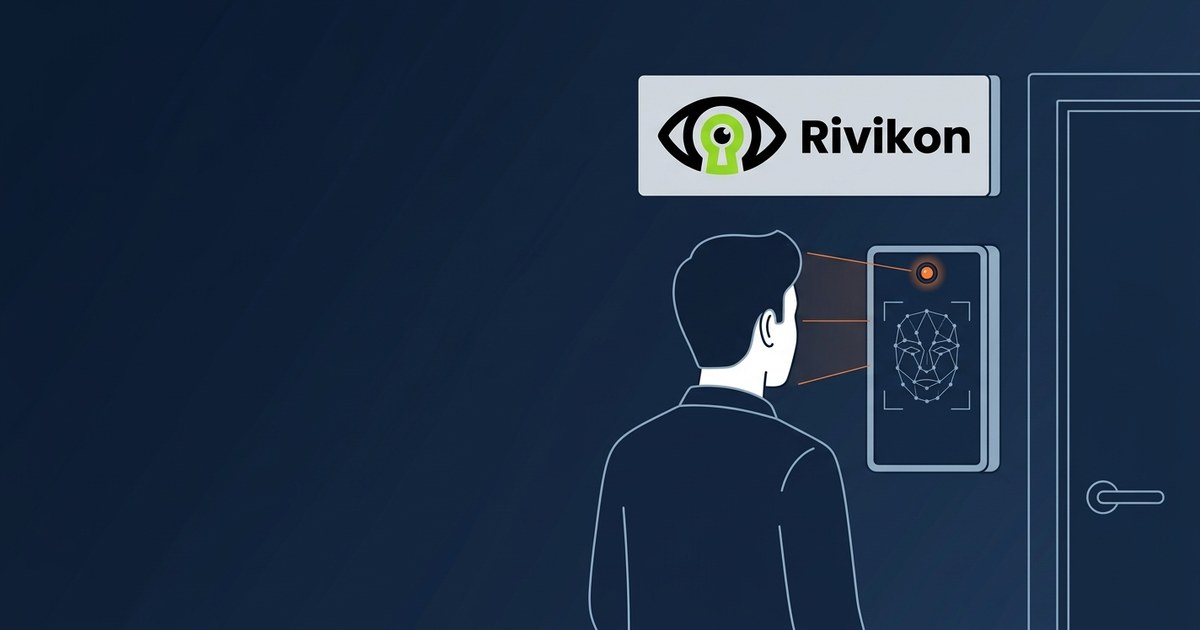
Facial recognition looks like the most convenient entrance there is: nothing to carry, nothing to lose, nothing to hand to someone else. Here is what sits behind it, and where it genuinely makes sense.
How does facial recognition work?
The camera captures the face and the software turns it into a set of numbers - a mathematical template of the proportions between features. On every later entry, a fresh template is compared against the stored ones and the system decides whether there is a match. The photo itself is usually not kept; the template is.
So recognition is not “comparing photos”. The system does not look at how you appear - it measures distances.
How it differs from a card and a plate
The three credentials solve different problems:
- A card opens for whoever is holding it. That is why it gets lost, handed on, and blocked when someone leaves.
- A licence plate identifies the car, not the person - ideal at a car park, useless at a pedestrian door.
- A face cannot be handed to anyone and cannot be left at home. In exchange it is the heaviest to introduce, and it cannot be replaced if it ever leaks.
That last difference is the important one: a lost card is blocked and reissued, while a face is replaced by nothing.
Where it is used
Most often where the group of people is small and known and access has to be strictly traceable - server rooms, laboratories, warehouses holding valuable stock, restricted areas in manufacturing.
It is also used for convenience at office building entrances, but there it usually runs alongside a card rather than instead of one.
What makes it hard
Three things reduce accuracy: weak or backlit conditions, a bad camera angle relative to the face, and anything covering part of the face. That is why terminals are mounted at face height with even lighting, rather than under a light from above.
There is a non-technical weight too. Face data counts as biometric data and in Europe is regulated more strictly than ordinary personal data - with requirements around a lawful basis, transparency and retention. Before introducing such a system, run it past a lawyer or your data protection officer.
When it is worth it, and when it is not
A face earns its weight when no lighter measure does the job.
For most sites there is a lighter measure. In a car park, the licence plate identifies the car without biometrics. In a gym, a card or QR code plus a turnstile solves the card-sharing problem. In an office building, a card with zone permissions covers nearly everything.
The rule is simple: introduce biometrics because the job demands it - not because it sounds modern.
What Rivikon offers today
The platform works with licence plate recognition, RFID cards, fobs, PINs and QR codes. Facial recognition is in development for high-security sites and is not delivered today.
If the topic is live for you, get in touch - we will tell you honestly which of the above solves your case now.
In short
- A face becomes a mathematical template; the photo itself is usually not kept.
- A card gets handed on, a plate identifies the car, a face identifies the person.
- A lost card is replaced, a face is not - which is why the requirements are higher.
- Accuracy drops in poor light, at a bad angle, and with the face partly covered.
- For car parks, gyms and most offices, a plate or a card does the job without biometrics.
Frequently asked questions
Is a photo of the face stored?
Usually not. What is kept is a mathematical template derived from the photo - a set of numbers the original image cannot be rebuilt from. Systems differ, so it is worth asking a supplier exactly what theirs records.
Does it work with glasses, a beard or a hat?
Usually yes. The template is based on the proportions of the face, not on hair or accessories. Changes that cover part of the face - a mask, or a low-peaked cap - do reduce accuracy.
Can it be fooled with a photo on a phone?
There is a separate check for that, called liveness detection. It tells a live face from a photo or a screen, usually by depth or by micro-movements. Systems without such a check are considerably easier to fool.
If you are looking for access control you can switch on today, see the parking system with plate recognition or access control for gyms.