How licence plate recognition (ANPR) works
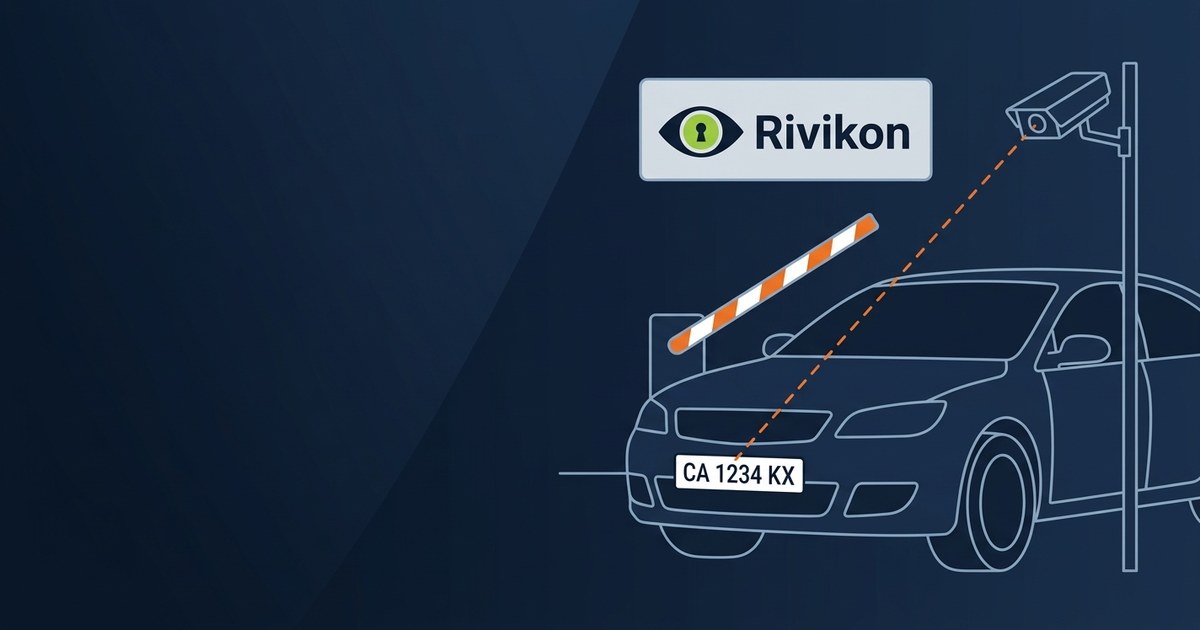
Between a car approaching the entrance and the barrier lifting, less than two seconds pass. To the driver it looks like a single motion, but four separate things happen inside those two seconds: the camera captures a frame, the software finds the plate in it, reads the characters and checks the number against a list of permissions.
This article walks through each step - what changes at night and in snow, what happens when a plate cannot be read, and what a site actually needs for any of it to work.
What is ANPR, and how does it differ from LPR?
ANPR (Automatic Number Plate Recognition) is a technology that reads a vehicle’s registration plate from a video frame and turns it into text. LPR (Licence Plate Recognition) is the same thing under a different name - the two abbreviations are used interchangeably. At a car park entrance, ANPR replaces the ticket and the card: the car is identified by its plate, and the software decides whether it may enter in under a second.
The only real difference between the names is where they come from. ANPR is the British usage; LPR and ALPR are the American ones. Vendor documents often mix all three, sometimes on the same page. If a supplier tells you ANPR and LPR are two different technologies, that is marketing, not engineering.
The recognition process, step by step
- The camera captures a frame. The entrance camera watches continuously and starts capturing a burst of frames as soon as a vehicle enters its field of view. The software then picks the most legible frame from the burst instead of betting on a single shot.
- Locating the plate in the frame. A frame contains tarmac, a radiator grille, headlights and half a building. The first job is to isolate the rectangle of the plate - by its shape, its contrast and the characteristic proportions of a registration plate.
- Reading the characters. The cropped plate is straightened and converted to text, character by character. This is where the classic ambiguities get resolved - 0 or O, 8 or B - helped by knowing how plates in the country are structured.
- Checking the list. The resulting text is matched against the site’s permissions: subscriber, staff member, guest with a booking, unknown vehicle. Each of those cases has its own outcome, defined by you in advance.
- The decision. The software sends a pulse over the relay connection to the barrier and writes the event to the log - with a photo, a timestamp and the plate that was read.
What can the camera read at night, in rain and in snow?
At night an ANPR camera does not rely on street lighting - it has its own infrared illumination, and the plate is retroreflective, so it shows up clearly in the infrared range. Counterintuitively, recognition at night is often steadier than on a bright afternoon with the sun facing the lens.
Rain and snow interfere less than people expect. The real enemies are three: a dirty or snow-covered plate, a bad mounting angle, and cars entering too fast. The first is up to the driver; the other two are settled at installation, by positioning the camera so it sees the plate almost head-on and from a distance that gives it time for several frames.
Recognition accuracy is above 99% with a properly mounted camera and a legible plate - but 100% does not exist, not for us and not for anyone else. Which makes the next section at least as important as this one.
What happens when a plate cannot be read
A good system is judged not by always recognising a plate, but by what it does when it does not. Several fallbacks work in parallel:
- A call button or intercom at the entrance - the driver reaches a person without leaving the car.
- Remote opening from the dashboard - whoever is on duty sees the live frame, recognises the car and lifts the barrier from their phone.
- A second access credential - an RFID card, a QR code on a phone or a PIN, for the cases where the plate is unavailable.
- A photo of every event - even a failed entry is recorded, so the case can be reviewed afterwards.
What a site needs for ANPR to work
Surprisingly little. The minimum configuration is three components: an ANPR camera, a Rivikon SmartBridge device and a relay connection to the existing barrier. The camera watches, SmartBridge decides on the spot, the barrier lifts.
The rest is environment: power and a network cable to the entrance, a sensible distance between camera and plate, an angle close to head-on, and enough room for a car to stop before it reaches the barrier. The full list, together with the optional components - intercom, LED display, terminals - is on the page about the components of a parking system.
ANPR, RFID or QR - when to use which
A plate is convenient because the driver carries nothing and never opens a window. That makes it the natural choice for subscribers, staff and guests with a booking - exactly how the hotel parking system works.
An RFID card suits places where access follows the person rather than the car - a company car park with rotating vehicles, for instance. A QR code is a single-use pass sent to a visitor’s phone. In a parking system with plate recognition the three are not mutually exclusive: the plate is the main path, the card and the code are the fallbacks.
In short
- ANPR and LPR are the same thing - automatic reading of a registration plate from a video frame.
- Recognition takes five steps and under a second; the slow part is the barrier mechanics.
- At night it works on infrared illumination and is often steadier than in direct sunlight.
- Above 99% accuracy is realistic; 100% is not - hence the intercom, remote opening and a second credential.
- The minimum for one entrance is a camera, SmartBridge and a relay connection to the barrier.
Frequently asked questions
How fast does an ANPR camera read a plate?
Reading the plate and deciding on access take under a second. The delay a driver feels comes almost entirely from the barrier mechanics, not from the software.
Does ANPR work at night?
Yes. ANPR cameras carry their own infrared illumination and do not depend on street lighting - the plate is retroreflective and shows up clearly in the infrared range. Recognition at night is often steadier than on a bright afternoon with the sun facing the lens.
What happens if the internet goes down?
The Rivikon SmartBridge device sits at the entrance and makes decisions locally rather than in the cloud. If the connection drops, known plates keep getting in and the events sync once the link is back.
Is a licence plate personal data?
A licence plate is treated as personal information because it can be linked to an identifiable person. That is why access to the event log is role-based and the retention period is configurable per site.
If you want to see how recognition would work at your entrance - with your barrier and your traffic - book a free demo.